Essays, expert commentary and press features connecting M.O.D.A.L. research with the public debate on Artificial Intelligence, Digital Twins, scientific computing and data-driven society.
8authored essays
4press features
2020–2025public engagement archive
OUTREACHExpert commentary · media · public engagement
Featured essay
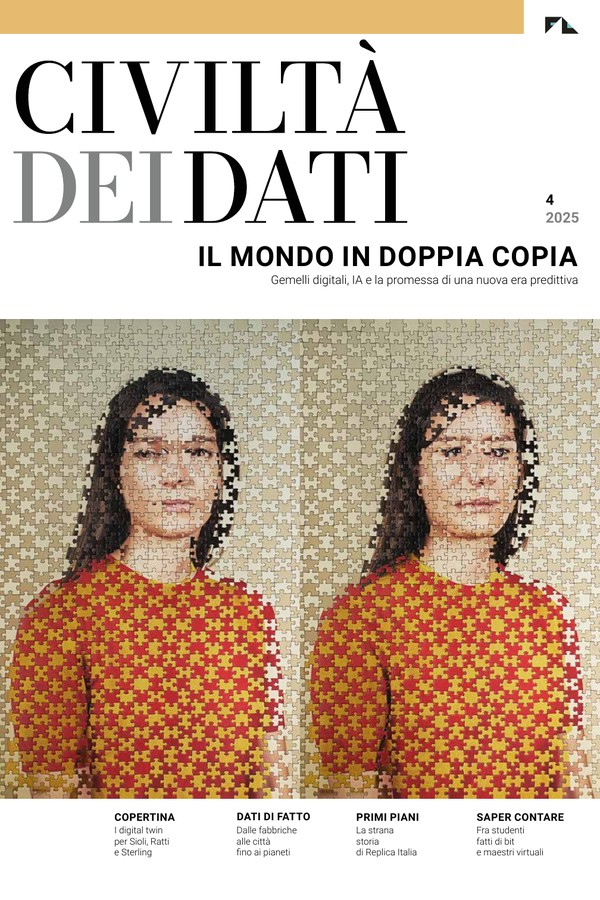
Civiltà dei Dati
Fondazione Leonardo ETS · Issue 4/2025 · Digital Twins special issue.
Featured · authored essay
Civiltà dei Dati · Fondazione Leonardo ETS
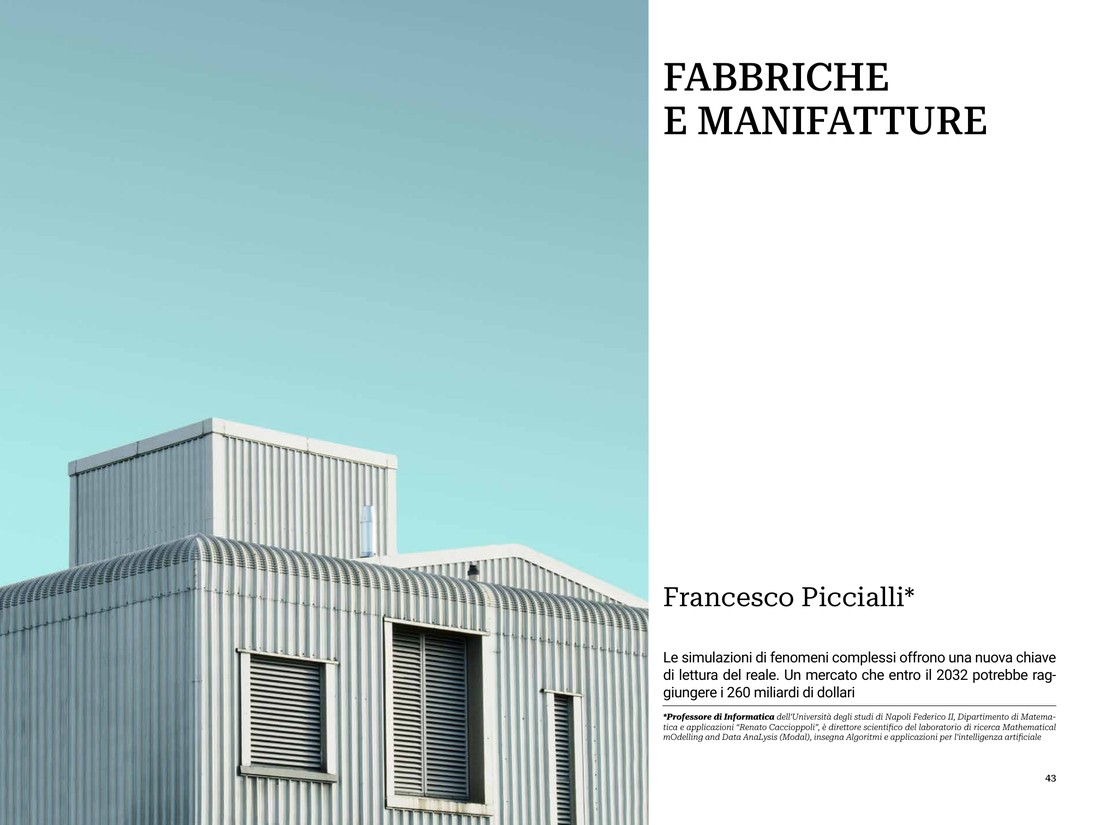
Fabbriche e manifatture
Francesco Piccialli · pp. 43–47
The essay examines the evolution of Digital Twins in manufacturing: from connected virtual replicas to intelligent, adaptive systems combining real-time data, AI, edge computing and federated learning. It also connects industrial twins with smart mobility and urban systems.
Articles authored by Francesco Piccialli and M.O.D.A.L. researchers for broader scientific and technological audiences.
Expert commentary
Agenda Digitale
Promette sostenibilità ma prosciuga risorse: il vero impatto ambientale dell’IA
Salvatore Cuomo · Fabio Giampaolo · Francesco Piccialli
A critical analysis of the environmental cost of AI, from energy and water consumption to hardware life-cycle impacts and computational responsibility.
Interviews, profiles and coverage of M.O.D.A.L., its scientific coordinator and research activities.
Press & feature
Il Roma
Francesco Piccialli tra scienza e futuro
Interview by Mimmo Sica
A long-form interview on the origins of M.O.D.A.L., research in AI and scientific computing, international collaborations and the role of technology in society.
«IA e ricerca matematica, ho scelto di tornare a Napoli»
Interview by Mariagiovanna Capone
An interview on academic choices, the decision to build research in Naples, M.O.D.A.L. and the development of AI and mathematical research at Federico II.
500 italiani e italiane che contano nell’Intelligenza Artificiale
Riccardo Luna
Francesco Piccialli is included in the national mapping of people shaping artificial intelligence in Italy, with M.O.D.A.L. highlighted among the research activities at Federico II.
Intelligenza artificiale, dalla Federico II l’algoritmo che decongestiona gli ospedali
Paola Marano
Coverage of Federico II research using artificial intelligence to forecast healthcare demand and support the decongestion of health facilities in Campania.
Biosensoristica e Intelligenza Artificiale per trovare contaminazioni batteriche
An institutional report on multidisciplinary research combining biosensing and Artificial Intelligence, connected to a publication in Sensors and Actuators B.
Official university coverage of partnerships and major research initiatives, separate from reports dedicated to individual papers.
Doctoral Network · 28 Jun 2024
Federico II protagonista della Doctoral Network TUAI
Federico II describes its role in the European MSCA Doctoral Network TUAI, including the group's research directions in federated learning, graph neural networks and language models.