
Learn under heterogeneity
Study algorithms for non-IID data, limited edge resources and variable connectivity. Compare accuracy, communication cost and computational requirements.
Federated Learning for INdustrial Twins
Connecting local learning, secure model aggregation and adaptive Digital Twins in edge-based environments
UNINA Principal Investigator · Francesco Piccialli
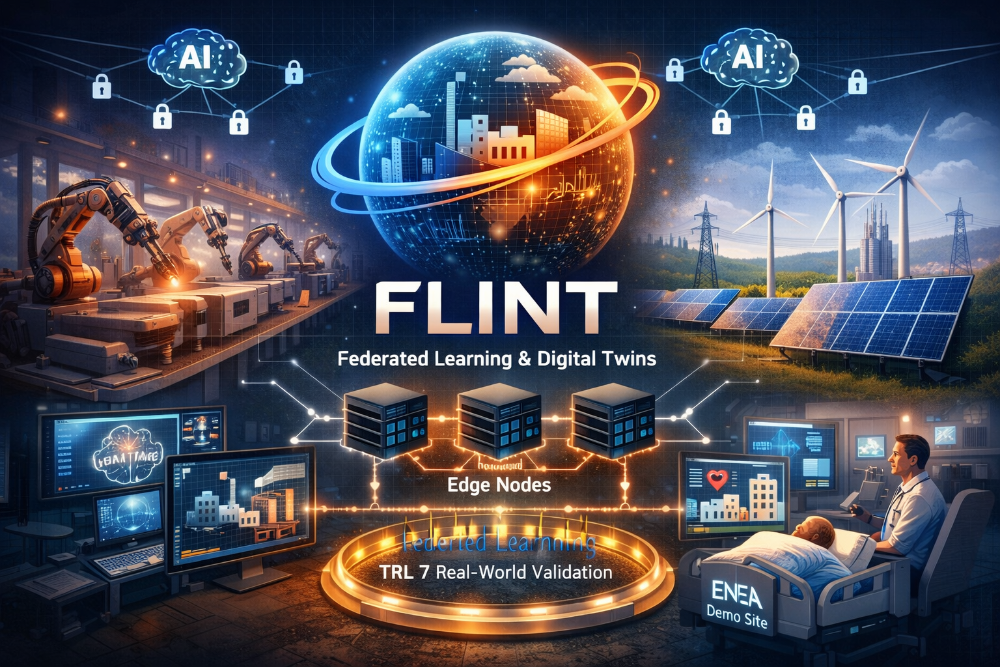
FLINT addresses the combination of distributed industrial data, limited edge resources and the need for adaptive Digital Twins. Its platform is designed to train models locally and coordinate their updates, rather than transferring raw operational data to a central training repository.
Federated learning is connected to Digital Twins that use learned predictions and new observations to update their state. The project brings together TPS for platform requirements and edge infrastructure, UNINA / M.O.D.A.L. for federated algorithms and privacy mechanisms, and OPIWARE for Digital Twin integration and operational validation.
An explanatory view of the intended components and information flow, based on the project work plan.
Local observations and training data
Raw data stays at the siteHeterogeneous devices and data
Raw data stays at the siteSite-specific operating conditions
Raw data stays at the siteHeterogeneity · Robustness · Privacy–utility trade-offs
The group’s industrial-research objective spans the full project. Its work combines algorithm design, robust protocols, privacy mechanisms and experimental validation.
Study algorithms for non-IID data, limited edge resources and variable connectivity. Compare accuracy, communication cost and computational requirements.
Implement federated protocols and investigate aggregation strategies, including weighted and clustered approaches suited to heterogeneous data and models.
Investigate differential privacy and secure aggregation, together with threats such as membership inference and model inversion. Quantify protection rather than assuming it follows from decentralisation.
Compare solutions using public and synthetic benchmarks, varying federation size, data heterogeneity and privacy settings. Produce experimental code and validation evidence.
Tasks and month ranges follow the project proposal, OR2. They describe the planned work rather than completed milestones. The scope is also reflected in the public UNINA research notice.
Define technical-scientific requirements, platform components and functional specifications.
Develop and validate the learning protocols and privacy mechanisms.
Integrate distributed AI with twin models, interfaces and adaptation mechanisms.
Develop the testbed, node management and federated orchestration.
Evaluate the integrated platform in productive environments and demonstrators.
FLINT targets applications in manufacturing, energy and healthcare. The planned validation examines predictive quality, efficiency, robustness and privacy at the algorithm level, then the behaviour of the integrated edge and Digital Twin platform.
Expected outputs include a federated-protocol library, privacy modules, reproducible benchmark experiments, adaptive twin prototypes and an integrated testbed. TRL 7 is the project’s validation target, to be assessed through operational evidence and demonstrators.
Discover the methods and publications behind the group’s research direction